
Free samples can be an asset or a hindrance to your Amazon influencer growth.
If you do it right, you can get tons of great products that actually make money.
If you do it wrong (like most people), you end up...
The problem is that most influencers treat creator connections like a slot machine. They send a handful of messages, get ignored, and decide brands "don't respond."
Or worse, they send lots of messages but aren't selective with what they're willing to accept. They take whatever they can get, end up with products with no profit potential, waste their time, and can even create an unplanned accounting nightmare.
Meanwhile, a small group of creators is getting a steady flow of products every week.
The difference isn't luck. It's having a real approach. Follow these 8 tips, and you'll start getting better products, more often.
One of These Is Mandatory
Sending messages to brands is nearly impossible without tools. Oink and Viral Vue both make it possible to send messages quickly and easily. They work very similarly, but it would be malpractice for me to tell you how to optimize this process and not tell you that these tools do most of the heavy lifting.
1. Optimize Your Storefront
Before a brand sends you anything, they're going to look at your storefront. Think of it as your résumé. Most brands will spend about 30 seconds on it, and those 30 seconds decide whether you get the sample.
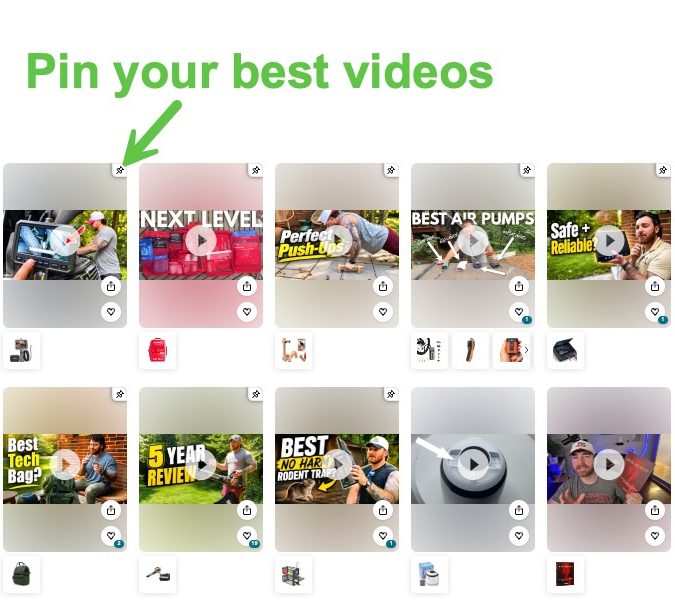
Pin your best videos. Brands watch the first videos that appear, so control what they see. The videos you pin don't need to be your top earners. They need to be the ones that make a brand think, "I want this person reviewing my product." Clean audio, good lighting, clear demonstration of the product. Put your best foot forward.
Get your profile picture and bio right once. This is a one-time job, so do it properly. A real photo of you (not a logo, not a pet), and a bio that tells brands who you are and what you review. You don't need to be clever. You need to look like a professional who will make their product look good.
Link your socials. Brands love influencers with reach off Amazon. Even if your TikTok or YouTube is small, linking it signals that you're a real creator with an audience, not just someone filming products in their kitchen for onsite commissions.
Niche down (sort of). This is a catch-22, and I want to be honest about it. I do not recommend limiting yourself to one niche as an Amazon influencer. If a product makes money, make the video.
But your storefront, bio, and pinned videos can be a slightly different story.
They can and should help you appeal to certain product types more than others. If your pinned videos are all kitchen gadgets, kitchen brands will feel like you're a fit. Use that to your advantage for the categories you most want samples in, without turning down money elsewhere.
2. Optimize Your Outreach Template
Your message is the second thing brands judge you on, and most templates are terrible. They're generic, they're all about the influencer, and they give the brand no reason to say yes.
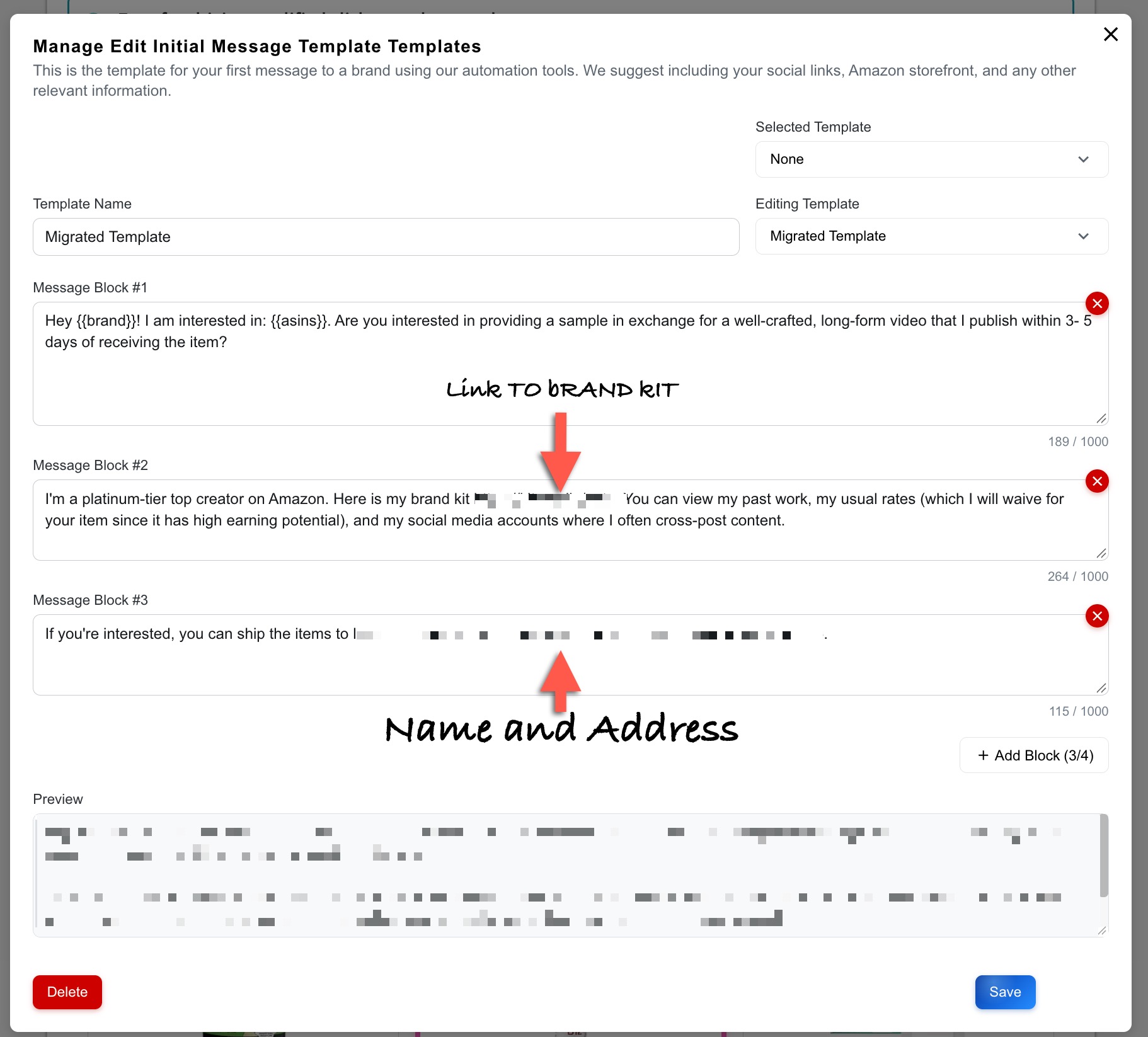
Here's what a good template looks like:
- Have multiple customized templates. One for electronics, one for supplements, one for home goods, and so on. A message that references the product category reads as personal even when it's mostly templated.
- Use placeholders. Product name, brand name, category. Fill them in every time. A message that clearly wasn't written for this brand gets ignored.
- Brag about yourself. This isn't the time for modesty. Tier status, number of videos published, categories you've had success in, offsite following. Brands are deciding whether to spend money on you. Give them reasons.
- Add value. Tell them what they get. A high-quality video on their product detail page, potential carousel placement, and (if you have it) offsite promotion. Frame it as what you'll do for them, not what you want from them.
Every template should be short enough to read in 15 seconds. Brand managers are scanning dozens of these. Make yours the easiest one to say yes to.
3. Build Your Offsite Reach
Here's something many influencers miss: the heart of Creator Connections is offsite traffic.
We're fortunate that we can get paid for onsite videos. That's a gift, and it's how most of us make our money. But from the brand's perspective, the real prize is a creator who can drive traffic to Amazon from somewhere else. That's what the program was built for.
If you have any kind of following on TikTok, YouTube, Instagram, or even a blog, you're immediately more attractive than an influencer who only makes onsite videos. Brands will send you better products, respond faster, and be more willing to work with you repeatedly.
You don't need a huge audience. You need to be able to say "I'll also post this to my [platform] where I have X followers." Start building that now, even if it's slow. It compounds.
4. Ask Consistently
My positive response rate is about 4%. Read that again. I'm platinum tier, I have a polished storefront, and I only reach out for products that meet my profitability criteria. Even with all of that, 96 out of 100 brands don't say yes.
That's not a reason to be discouraged. It's a reason to send a lot of messages. If you want products at scale, you need to ask at scale. Ten messages a week gets you nothing. A hundred messages a week gets you four products. Do that every week and you have a pipeline.
Pro Tip: If You're Going to Skip Messaging, Skip Weekends
Positive response rates on weekends are noticeably lower. If you message on Saturday or Sunday, your message sits in a queue with everything else that came in, and by the time the brand manager is back in the office on Monday, you're buried.
If you're going to take a day off from outreach, make it the weekend. Save your message allotment for Monday through Friday when someone is actually reading them.
Brand outreach is the perfect job to outsource to a low-cost virtual assistant. Paying someone $4–$5 per hour to contact brands on your behalf for one to two hours per day is one of the best investments you can make in this business. It frees you up to do the thing only you can do: make the videos.
5. Message Brands After You've Published Their Videos
Brands that have worked with you once are exponentially more likely to work with you again, especially if the video you made for them was high quality. They already know you deliver. You've skipped the hardest part of the sale.
Most influencers never follow up after submitting a video. That's a huge missed opportunity.
Use automations through Oink or Viral Vue to send a confirmation message to every brand the moment you submit your video for their item. Thank them, tell them the video is live, and end the message with:
"I'd love to continue working with you. Do you have any other ASINs you need similar videos for?"
Brands almost always have more products than they have creators. One good video can turn into an entire catalog.
(If you use either tool, code EAM gets you 10% off.)
6. Follow Up
Viral Vue has a great feature that lets you message brands that ghosted you.

Following up with brands who ignored you the first time.. People get busy. Messages get buried. A follow-up a week later often gets a response that the original never would have.
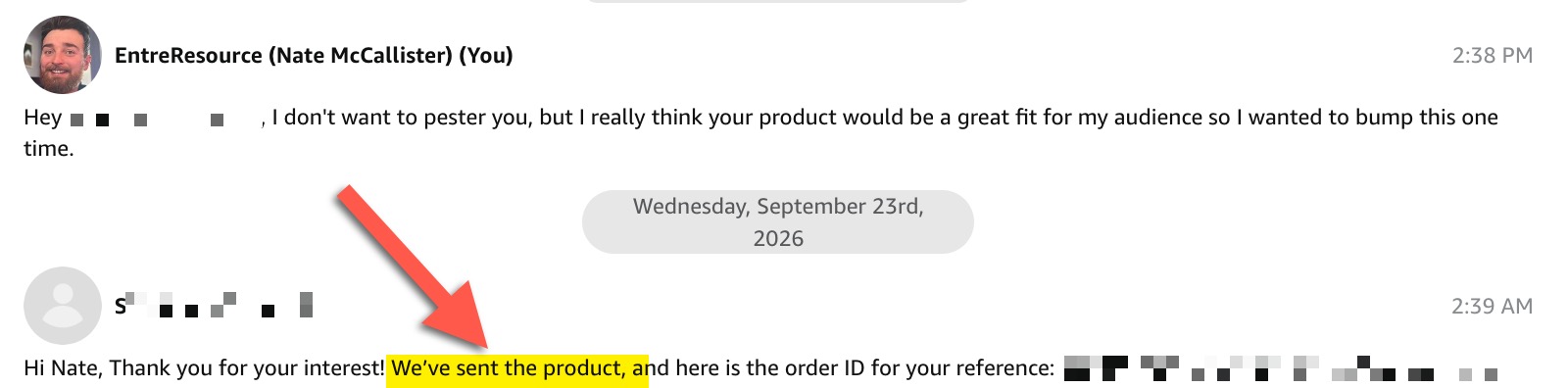
It's also a time saver. In Viral Vue, sending up to 100 follow-up messages is a single click. There's no reason not to do it.
7. Ask Early
If you're gold tier or higher, you get early access to campaigns before lower tiers can see them. Use it.
Brands often have a very limited number of samples to distribute. When a campaign goes live, the first creators to reach out have a real advantage. Hit those brands before everyone else does, and you'll get samples that are gone by the time most influencers even see the campaign.
This is one of the underrated benefits of climbing the tiers. It's not just about the campaign counts. It's about being first in line.
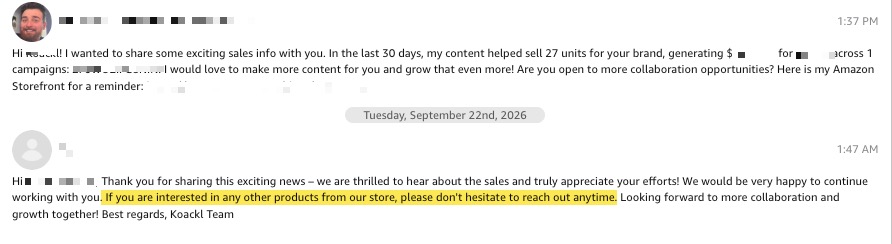
8. Update Brands on Your Earnings
Both Viral Vue and Oink have the ability to send brands messages that look like this.
What's Next?
If you want to learn more about affiliate marketing and the Amazon influencer program, come join me over at my Skool community, Evergreen Affiliate Marketing.
And of course, don't forget to get started (for free) with Viral Vue or Oink if you're serious about making free sample products work for you!