

Outsourcing content writing means paying outside writers, freelancers or a content team to produce some or all of your articles while you keep control of strategy and quality. It works when you know your audience, have a clear brief and a simple review process. It fails when you hand over a vague idea and hope for the best. Below is how to decide what to hand off, hire freelance blog writers, brief them, manage the work and tell whether it is paying off.
TL;DR
- Outsource when you lack time, dislike writing, need expertise you don’t have, or have budget to publish more. Settle your messaging and audience first.
- Define content type, volume, length, expertise and budget before you contact a single writer.
- A written brief and a style guide cut revisions more than any other single step.
- Outsourcing doesn’t remove management: you still assign topics, review drafts and track results.
- Set goals before the first article ships, then share performance data with your writers.
Table of Contents
- When outsourcing content writing makes sense
- What you can outsource
- Step 1: Take inventory before you hire
- Step 2: Set a budget and a payment model
- Step 3: Find and vet freelance writers
- Step 4: Write a brief that prevents rewrites
- Step 5: Build a workflow you can run in an hour a week
- Quality and risk: what to watch
- Measure whether it’s working
- Our perspective
- Want a shortcut? Start with our course
- FAQ
- Sources
When outsourcing content writing makes sense
The practical reasons are simple. Ahrefs lists lack of time, dislike of writing, a need for specialist expertise, and an existing content budget as the situations where it pays off. If any of those describe you, you’re a candidate.
You’re not alone. In the Content Marketing Institute’s 2021 B2B survey, 49% of respondents outsourced at least one content marketing activity, and content creation was the activity outsourced most often. Search Engine Land reported in 2023 that roughly half of companies outsourced content writing, and about one in ten stopped because results fell short of expectations.
That last number is the one to take seriously. Most failed outsourcing comes from a missing foundation, not from bad writers.
Time is the biggest lever
Writing well is slow. One company guide estimates that a well-researched 1,000-word article can take around 6 hours, and a piece that needs interviews or data analysis can take 10 hours or more. If you publish weekly, that is a part-time job. For a solo founder, blogger or small business owner, those hours are often better spent on offers, partnerships and customers.
When to wait
Outsourcing is a poor first step when your messaging, positioning or ideal customer are still unsettled. One content agency puts it bluntly: in those cases outsourcing magnifies the chaos. If you can’t describe your reader and your point of view in a paragraph, write a few pieces yourself first. Those pieces become the reference your writers learn from.
The Content Marketing Institute also notes that trade secrets, proprietary information or controversial ideas may be better kept in-house when you need tight control of the message. Plan on keeping those pieces with you or a trusted insider.
What you can outsource
Outsourcing isn’t all or nothing. Think of your content process as a chain: ideas, keyword research, outlines, drafting, editing, images, formatting, publishing and promotion. Outsourcing blog writing can mean handing off any slice of that chain, up to a partner who builds and manages the whole program.
Common tasks to hand off:
- Blog posts and guides. The classic starting point, especially how-tos, listicles and explainers.
- Product reviews and comparisons. Fine to outsource if you supply hands-on notes, screenshots and your honest verdict.
- Email newsletters and sequences. Writers can draft; you add the personal opening.
- Case studies and interviews. The writer does the interview or turns your notes into a story.
- Editing and proofreading. Many bloggers keep drafting and outsource polish only.
- Production work. Uploading to your CMS, formatting, adding links and images.
The Content Marketing Institute recommends deciding whether a writer is responsible only for drafting or also for editing, links, images, social distribution and CMS work. Put that in writing. Unstated duties are where most scope arguments start.
My rule of thumb: keep what only you can say (opinions, personal results, original data) and outsource the structure, research and first draft around it.
Step 1: Take inventory before you hire
The Content Marketing Institute advises taking an inventory first: content types, topics, formats, platforms, word counts, research or interview needs, distribution duties, volume, goals, governance, tools, team access, budget, payment model and legal constraints.
That sounds like a lot. In practice, answer these six questions on one page:
- How many pieces per month do you need?
- What is the typical length and format?
- How much subject expertise does the writer need?
- Who edits, and who publishes?
- What is the monthly budget?
- What does success look like in 90 days?
Ahrefs adds a useful warning: more industry knowledge generally means higher cost. A general lifestyle topic can go to a capable generalist. Software, finance or health content needs someone who already knows the field, or an expert reviewer on your side.
Step 2: Set a budget and a payment model
The Content Marketing Institute notes that freelancer rates may exceed in-house writer pay because freelancers cover their own employment taxes, insurance and benefits. It suggests three arrangements: per project, retainer or hourly.
| Model | Best for | Watch out for |
|---|---|---|
| Per project (per article) | Occasional posts, clear scope | Extra fees for research, images or revisions if not agreed upfront |
| Per word | Simple, repeatable articles | Padding to hit a word count |
| Retainer | Steady monthly volume, a long-term writer | Paying for capacity you don’t use |
| Hourly | Editing, strategy, unpredictable tasks | Costs that drift without a cap |
Whatever you choose, agree what’s included: research, one round of revisions, images, formatting. Then run a paid trial piece before you commit to a volume. Quotes vary widely by writer experience and niche, so get two or three before settling on a number.
Budget for your own time too. Outsourcing saves hours but doesn’t erase them, a point we come back to below.
Step 3: Find and vet freelance writers
Where you look matters less than how you screen. Search Engine Land cited a Semrush survey in which 47.06% of companies used reputable freelance writers when outsourcing content. Typical sources include freelance marketplaces, content marketplaces where you post an assignment, writer job boards, referrals from other site owners, and agencies.

Freelancers are usually the most economical route for a blogger or small team. Agencies make more sense when you need volume, editors, strategists and project managers under one contract. If you’re evaluating agencies, a verified agency directory can help you compare profiles, client reviews and fees, particularly if your business is in Australia. For a roundup of AI-assisted options, we reviewed AI-powered content agencies in more detail.
What to check
Ahrefs’ guidance is to review samples and experience, ask about niche knowledge and attention to detail, and see whether candidates follow instructions and deliver reliably. Turn that into a short screen:
- Samples in your niche. Read two or three. Do they teach something, or just restate the top search results?
- Instruction test. Send a short brief with five specific requirements. How many did they meet?
- Communication. Did they ask smart questions before starting?
- Reliability. Ask how they handle deadlines and what happens if they fall behind.
- Subject depth. Ask them to outline a post for you. A real expert will point out angles you missed.
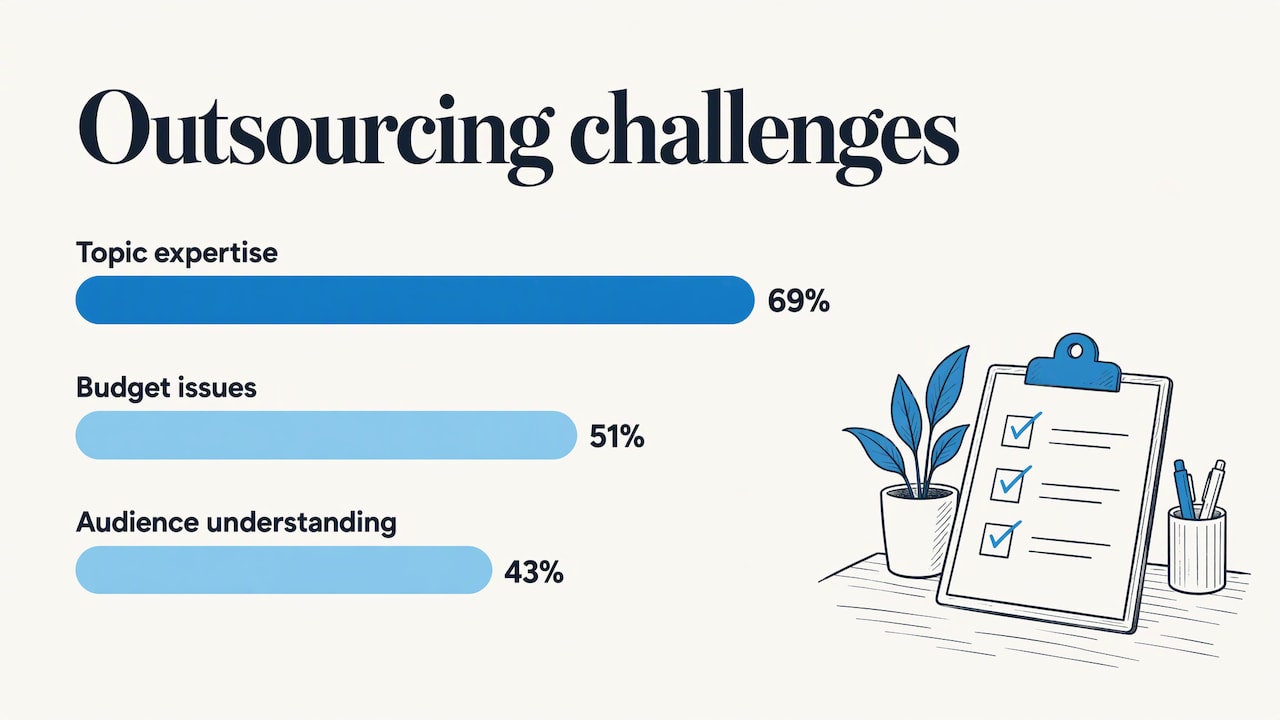
Expertise is the hardest thing to find. The Content Marketing Institute survey found that finding partners with adequate topic expertise was the top outsourcing challenge at 69% of respondents, ahead of budget issues (51%) and finding partners who understand the audience (43%). Plan your screening around those three.
If you’re weighing a content marketplace, we wrote about the experience from a buyer’s seat in our guide to outsourcing high-quality blog content on any budget.
Step 4: Write a brief that prevents rewrites
A good brief is the cheapest quality control you’ll ever buy. The Content Marketing Institute says a good brief makes expectations specific, focuses the creator, improves accuracy and reduces editing labor. Its checklist covers the title, client, deadline, angle, message, purpose and audience, specifications, submission method, contacts, resources and agreed fee.
Here’s a version you can copy:
- Working title and target keyword. Include the search phrase and a few related questions to answer.
- Reader. Who they are, what they already know, what they want to do next.
- Angle. Your point of view in one or two sentences.
- Structure. Suggested headings, or a request for an outline first.
- Length, format and tone. Link to two published examples you like.
- Sources and rules. What counts as a good source, what claims need links, what to avoid.
- Links and calls to action. Which internal pages to link, which offers to mention.
- Deadline, fee and revision terms. Say how many revision rounds are included.
Attach a style guide: voice, spelling, formatting, banned phrases and examples of good and bad paragraphs. The Content Marketing Institute also recommends giving writers your documented content strategy, editorial plan, subject-matter-expert contacts, performance data, technical resources and templates. If your SEO process includes tools, tell writers which ones. Our list of SEO tools for content writing is a good starting point for deciding what to give them.
Step 5: Build a workflow you can run in an hour a week
The Content Marketing Institute describes a typical workflow as outline, write, review, edit and approve, with milestones, dependencies and one person responsible for moving each item along. For a small site that might look like this:
- You or your editor approves the topic and brief.
- The writer submits an outline within a few days. You approve or adjust it.
- The writer delivers the draft by the deadline.
- You review against a checklist and send one consolidated round of feedback.
- The writer revises, you approve, and the post is formatted and published.
The same source says approval criteria should explicitly cover spelling and grammar, accuracy, readability, voice and tone, and policy or legal requirements. Write them down so “good enough” isn’t a mood.
On the practical side, writers may need access to a CMS, stock-image accounts, cloud collaboration tools, keyword requirements, metadata structures and file-naming conventions. Set these up once. We run our own editorial calendar in a shared workspace, and our walkthrough on managing your content workflow in Notion shows one way to do it.
The Content Marketing Institute’s governance guidance is worth a skim too: documented workflows that clarify roles from ideation through publication, plus templates, a style guide and an editorial calendar.
Giving feedback that sticks
- Batch your comments into one round instead of trickling them in.
- Explain the why: “our readers are beginners, so define this term” teaches more than a rewrite.
- Praise what worked. Writers repeat what gets noticed.
- If the same issue appears twice, fix the brief, not the draft.
Quality and risk: what to watch
Search Engine Land lists the common risks as unreliable delivery, inconsistent quality and weaker brand understanding, against upside in capacity, specialist skills, flexibility and speed. You manage those risks with process:
- Unreliable delivery: agree deadlines in writing, build a buffer into your calendar, and keep a backup writer.
- Inconsistent quality: use the same brief template and checklist every time, and keep samples of your best posts.
- Weak brand understanding: give new writers a reading list of your top posts and let them ask questions early.
- Accuracy: require sources for every number and check them yourself before publishing. If you use AI-assisted drafts, ask writers to disclose it and run the same review.
A proofreading tool helps catch the small stuff before you read for substance. Whatever you use, a human should still read for accuracy and voice.
Measure whether it’s working
Set KPIs before commissioning work. The Content Marketing Institute gives leads, page views, comments and conversions as examples, and recommends giving writers access to performance reports so they can improve.
For a blog, a simple scorecard works:
| Metric | Why it matters | Check |
|---|---|---|
| Organic clicks and impressions | Are posts getting found? | Monthly, per post, after 60 to 90 days |
| Time on page and scroll depth | Do readers stay? | Monthly |
| Email signups or product clicks | Is content driving action? | Monthly |
| Cost per published post | Is the budget sustainable? | Quarterly |
| Revision rounds per post | Is the brief working? | Per post |
Don’t judge a single article after a week. Review a batch of five to ten after a quarter, keep the writers whose pieces hit the goals, and update the brief for the rest.
Our perspective
We’ve bought and published outsourced content for years, and the pattern is consistent: the writer is rarely the problem. The brief is.
Most beginners outsource before they know what a good article looks like in their niche. They get generic copy, blame the writer and conclude outsourcing doesn’t work. Write a few posts yourself, find the structure and voice that earn readers’ trust, then hand that standard to someone else.
Our approach is practical. Keep your opinions, results and original ideas. Outsource research, drafting and polish. Pay fairly, run a paid trial, and give one clear round of feedback. Treat your best writers like partners and they will repeat what works.
That’s the thinking behind the guides, reviews and how-tos we publish: real-world tested, candid, and built to save you from mistakes we have already made.
Nathaniel
Want a shortcut? Start with our course
If you want the systems behind a profitable online business without piecing them together yourself, our Instant Course Access for Life gives you lifetime access for a one-off $97. It’s built for entrepreneurs, bloggers and freelancers who want practical, step-by-step training they can return to at any time. You can see what’s inside on the course access page.

Prefer to start free? Our free downloads page has resources you can use right away, and you can pair them with our guide to blogger SEO tips when you write your first briefs.
FAQ
How do I hire freelance writers for my blog?
Define your content type, expertise needs and budget first. Then review samples, run a short paid trial on a real topic, and check whether the writer follows your brief and hits the deadline. Start with one or two writers before building a bigger bench.
How much does it cost to outsource blog writing?
It depends on length, research depth and the writer’s expertise. The Content Marketing Institute notes that rates can be per project, retainer or hourly, and that freelancers price in their own taxes and benefits. Get two or three quotes for the same brief and compare what each includes.
Will readers know the content is outsourced?
Not if your brief, style guide and editing do their job. Give writers examples of your voice, add your own stories and opinions, and review every draft before it goes live. Consistency comes from your standards, not from who types the first draft.
Should I outsource everything or keep some writing in-house?
Most small sites do best with a mix. Keep content built on proprietary information, personal results and strong opinions, and outsource research-heavy or repeatable pieces. The Content Marketing Institute suggests keeping sensitive or controversial material close when message control is critical.
Sources
- How to Outsource Your Content to Freelance Writers (Ahrefs)
- A complete guide to outsource blog writing (eesel)
- Insourcing vs. outsourcing: the pros and cons for content creation (Search Engine Land)
- B2B Content Marketing 2021 report (Content Marketing Institute)
- How to Outsource Content Writing? (ContentBeta)
- The Content Marketing Book of Answers: Managing Your Content
- Outsourcing Content Creators: A How-To Guide
- Content Development and Writing Outsourcing
- How To Develop a Great Creative Brief
- How to Define a Workflow That Keeps Content Production On Track
- Content Governance Is a Must for a Successful Content Strategy