

To hire a podcast editor, decide what kind of editing you need, set a per-episode budget, ask for a paid test edit on your own raw audio, and put the specs in writing. Most interview shows can expect to pay $150 to $500 per episode for a standard 45 to 60 minute recording. Storytelling shows cost more.
The hard part is not finding someone. It is knowing what you are buying. “Editing” can mean removing a hum, or it can mean rebuilding an episode around a narrative. This guide walks through both, with numbers, a vetting process and a brief you can copy.
TL;DR
- Freelance podcast editing runs about $40 to $120 per hour, or $150 to $500 per episode for a typical interview show. Full-service retainers start around $700 a month.
- Define “technical repair” versus “creative storytelling” before you talk to anyone. That one distinction prevents most editor-client friction.
- Pay for a test edit using your own raw files, and listen to two or three full sample episodes, not one polished clip.
- AI tools can cover basic cleanup for $13 to $40 a month, but they do not replace a human for pacing, narrative and final mastering.
- Put loudness targets, turnaround, file formats and revision limits in writing before the first episode.
Table of Contents
- Decide what kind of editing you need
- What a podcast editor costs in 2026
- Freelancer, studio or AI: how to choose
- Can AI edit your podcast instead?
- Where to look for an editor
- How to vet a podcast editor
- Technical specs to put in your brief
- Red flags to avoid
- Working with your editor once hired
- Our perspective
- Build the rest of your content business
- FAQ
- Sources
Decide what kind of editing you need
Practitioners keep saying the same thing: clients treat “editing” as one task when it is a spectrum. At one end is technical cleanup: removing hums and pops, trimming dead air, cutting filler words. At the other is creative production: pacing, music, sound design and shaping a story. Clarifying which one you want is, in one practitioner’s view, the single most important step in avoiding friction with an editor.
Here is a quick way to place your show.
| Show type | What you probably need | Typical editor profile |
|---|---|---|
| Solo or two-person chat | Noise cleanup, filler and tangent cuts, level matching | Freelance editor comfortable with fast turnarounds |
| Interview show with guests | All of the above, plus guest audio matching and intro/outro assembly | Freelancer or small editing studio |
| Video podcast | Audio edit plus multi-camera cuts and clips | Editor with both audio and video experience |
| Narrative or documentary | Story structure, scoring, multi-track mixing, sound design | Experienced producer-editor |
If you also publish video, think about whether one person can handle both. We cover that decision in our guide to hiring a video editor in one sitting, and most of the vetting advice carries over.
What a podcast editor costs in 2026
Prices vary widely, so treat any single figure with suspicion. Two rate references agree on the hourly range: $40 to $120 per hour for freelance podcast editing. One report puts a standard episode at $150 to $500 and full-service retainers, which bundle editing with show notes and social clips, at $700 to $2,000 or more per month.
| Option | Typical cost | Best for |
|---|---|---|
| AI cleanup tools | $13 to $40 per month | Solo shows, tight budgets, basic cleanup |
| Freelancer, hourly | $40 to $120 per hour | Shows with irregular episode lengths |
| Freelancer, per episode | $150 to $500 per episode (45 to 60 minute interview) | Weekly or biweekly interview shows |
| Narrative editing | $500 to $2,000 or more per episode | Story-driven, heavily produced shows |
| Production retainer | From $700 to $2,000 or more per month | Shows that want editing, notes and clips handled together |
These figures come from published industry reports, not from us, and they will drift. Use them to sanity-check quotes rather than to set a fixed budget.
How to read a quote
A per-episode price means little until you know what it covers. Ask each candidate to list, line by line:
- Maximum raw recording length included.
- Whether filler-word removal and tangent cuts are included or billed extra.
- Whether mixing and mastering are included.
- How many revision rounds you get.
- Whether show notes, audiograms or social clips are bundled.
Two quotes of $200 and $350 may describe very different work. The cheaper one might be cleanup only, while the other includes content editing and mastering.
A worked example
Suppose you run a weekly interview show with 60-minute recordings. At a per-episode rate in the middle of the reported range, say $300, you would spend about $1,200 in a four-episode month. That is already inside retainer territory, so it is worth asking a studio what a retainer would include for the same money. If it adds show notes and a few clips you would otherwise make yourself, the retainer may be the better deal. If you only want clean audio, stay with the per-episode price.
Freelancer, studio or AI: how to choose
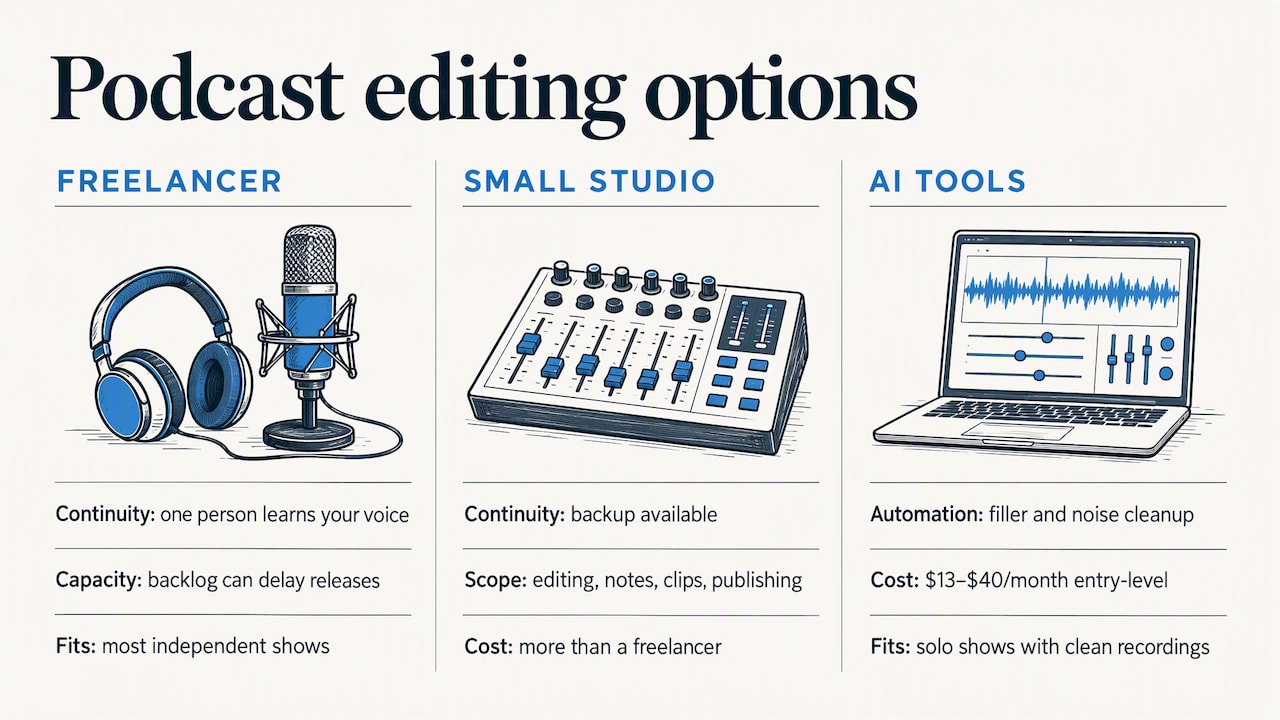
A freelancer suits most independent shows. You get one person who learns your voice, your pacing and your pet peeves. The risk is capacity: if they get busy or disappear, your release schedule slips. Ask how they handle vacations and backlog.
A small studio or production service costs more but gives you backup and a broader skill set. It makes sense when you want editing plus show notes, clips and publishing handled as one package.
AI tools handle the repetitive part. Entry-level options can automate filler removal and noise-floor reduction for as little as $13 to $40 a month. For a solo show with clean recordings, that can be enough, at least while you find your footing.
Can AI edit your podcast instead?
Partly. Think of AI as a very fast assistant that cannot hear what your episode is trying to be.
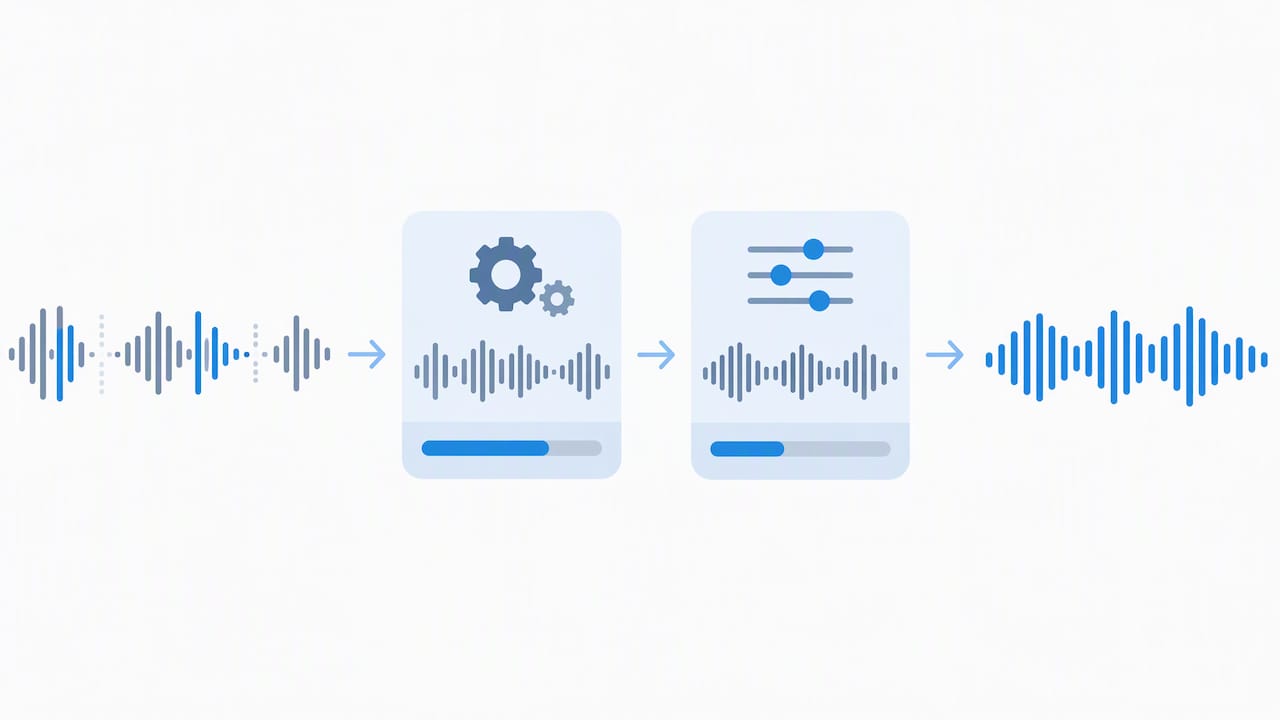
Transcript-based editors let you cut sentences by deleting text. Experts describe them as highly efficient for content editing, such as cutting tangents, but not a replacement for a traditional audio workstation like Adobe Audition or Reaper at the final mixdown and mastering stage. Many professionals use a hybrid: content edit in a transcript tool, then export to a workstation for EQ, compression and loudness normalization.
There is also a difference between editing for the eye and editing for the ear. AI can make language-level cuts, but smoothing pacing and managing transitions still takes manual work. Skip it and the episode can sound like a choppy, computer-made montage.
If you use AI enhancement yourself, do not push it to the maximum. Practitioners recommend setting enhancement intensity to roughly 60 to 70 percent to avoid the robotic, underwater sound that gives away an amateur production.
Want to explore the tool side first? Our roundup of AI tools for entrepreneurs is a good starting point for what is available beyond chatbots.
A sensible split
A hybrid often works best for a growing show: let software handle the first rough pass, then pay a human editor for the part that needs ears. That usually lowers the hours you are billed and keeps the human focused on pacing and polish. Ask any editor you interview whether they already work this way, and whether they pass the savings on.
Where to look for an editor
You have four realistic routes.
- Referrals from other podcasters. Ask in the communities you already belong to which editor they use and how long they have stayed. Longevity is a strong signal.
- Freelance marketplaces. These give you the widest pool and let you post a job and collect bids. Quality varies enormously, so the vetting steps below matter more here.
- Editing and production companies. Search for studios that publish sample work and clear pricing tiers.
- Editors’ own portfolios and sites. Many solo editors list rates, sample reels and turnaround times. Contact two or three directly.
An editor with a background in broadcast or radio can be an excellent fit for interview formats, because they bring technical discipline and a trained ear. Whatever the background, judge the work, not the label.
How to vet a podcast editor
The most common mistake new podcasters make is hiring on price rather than demonstrated experience with their format. Someone excellent at basic cleanup for chat shows may lack the narrative skills a story-driven show needs. Use this process to avoid that.
Step 1: Listen to full episodes
Ask for two or three complete sample episodes in a format like yours. A single polished clip hides inconsistency. You are listening for steady pacing, natural-sounding cuts, consistent levels between host and guest, and no breathing or room tone that jumps in and out.
Step 2: Run a paid test edit
Send the same 10 to 15 minutes of your own raw audio to your top two or three candidates and pay each for the work. It costs a little, but it shows how they handle your voices, your room and your guests. Include a messy section on purpose: crosstalk, a bad guest connection, a long tangent.
Step 3: Compare the notes, not just the audio
Good editors ask questions and flag issues. Did they ask what to keep and what to cut? Did they tell you about a clipping problem in a guest track? An editor who only returns a file, with no notes, gives you less to work with than one who explains decisions.
Step 4: Check process and reliability
Ask about:
- Turnaround time from receiving files to delivering a first draft.
- File-delivery method and format.
- Backup plan if they are unavailable.
- How they take feedback and how many revisions are included.
Step 5: Start with a trial period
Begin with two or three episodes before committing to a retainer or long contract. If the first drafts need fewer corrections each time, you have found a fit.
Technical specs to put in your brief
You do not need to be an audio engineer, but you should know enough to write specs down. Two numbers matter most for final delivery.
- Loudness: The commercial consensus for stereo podcast mastering is an integrated loudness of -16 LUFS. Some platforms, Spotify among them, may recommend louder targets, often -14 LUFS. Targeting -16 helps prevent Apple Podcasts from applying heavy compression that degrades quality.
- True peak: Cap it at -1.0 dBTP. Mastering to this limit is standard practice to prevent inter-sample clipping when a high-quality WAV or AIFF file is converted to MP3 or AAC. Distortion from this problem is something AI tools often cannot fix.
Platform guidance changes, so ask your editor to confirm current targets for the platforms you care about. You can also spot-check a delivered file yourself with a loudness compliance plugin for Audacity, though its authors note that such checks guide rather than guarantee how any service will treat your upload.
A brief you can copy
Send something like this to every candidate, so quotes are comparable:
- Show format: interview, two hosts, 45 to 60 minutes raw, weekly.
- Scope: noise reduction, level matching, filler and tangent cuts, intro and outro assembly, mastering. (Remove any line you do not want.)
- Style: conversational, keep natural pauses, cut only distracting fillers.
- Delivery: MP3 and WAV, mastered to -16 LUFS with a -1.0 dBTP ceiling.
- Turnaround: first draft within a set number of days of receiving files.
- Revisions: a stated number of rounds, with what counts as a revision.
- Extras: show notes, clips or chapter markers, quoted separately.
- Raw files: separate tracks per speaker when possible, shared through a link you control.
Red flags to avoid
- No sample work in a format like yours.
- A price far below everyone else’s with no explanation of what is cut.
- Vague scope. If “editing” is not itemized, expect disputes later.
- No revision policy.
- Unwillingness to do a paid test. Good editors usually understand why you ask.
- Over-processed samples. If every sample has the same heavy enhancement effect, the editor may lean on filters instead of judgment.
Working with your editor once hired
The first month decides whether the relationship lasts. A few habits help.
- Give written feedback with timestamps. “Cut at 14:32, the story about the vendor” beats “it feels slow.”
- Share a style guide. Note which fillers you tolerate, how aggressive cuts should be, and any recurring segments.
- Record clean audio. No editor can fully fix a poor recording. Good microphones, a quiet room and separate tracks per speaker cut editing time, which can lower what you pay.
- Keep a shared folder structure. Raw files, drafts and finals in separate folders prevents confusion.
- Review the first three drafts closely, then loosen your oversight as they learn your taste.
Our perspective
We run an affiliate blog and an email list built on one idea: the quickest way to grow an online business is to stop doing every task yourself, but only once you know what good looks like. Podcast editing is a textbook case.
Our view is that most new podcasters should not hire on day one. Edit your first few episodes yourself, even badly, so you learn what a clean edit sounds like and which parts you hate doing. Then hire for those parts. You will write a better brief, ask sharper questions and spot weak samples quickly.
When you do hire, spend your money where judgment matters. Software is cheap and getting better at cleanup. A human editor earns their fee on pacing, on knowing what to cut and on protecting your sound at the mastering stage. Pay for that, and use tools for the rest.
And do the paid test. It is the cheapest insurance in the whole process.
— Nathaniel
Build the rest of your content business
If you are outsourcing editing so you can spend time on growth, our lifetime-access offer, Instant Course Access for Life, is $97 one-time. You can also browse our free resources first if you want to look around before spending anything.
FAQ
How much does it cost to hire a podcast editor?
Freelance podcast editors commonly charge $40 to $120 per hour, or $150 to $500 per episode for a standard 45 to 60 minute interview show. Narrative shows run $500 to $2,000 or more per episode. Retainers that include show notes and clips usually start around $700 a month.
Can AI edit my podcast?
AI can automate basic cleanup such as filler removal and background noise reduction, for roughly $13 to $40 a month. It cannot replace a human editor for storytelling, multi-track mixing or sound design. Many shows use a hybrid, with AI for the first pass and a person for pacing and mastering.
Should I pay for a test edit?
Yes. Send the same 10 to 15 minutes of your own raw audio to two or three candidates and pay each. You will learn how they handle your voices and your room, and you will see whether they ask useful questions. A paid test is far cheaper than a bad month of episodes.
What should I give a new editor before the first episode?
Give them a written brief: show format, scope of work, style notes, delivery formats, loudness targets, turnaround and revision limits. Add separate raw tracks per speaker and a timestamped list of any known problems. The clearer the brief, the fewer revision rounds you will need.
Sources
- Podcast Editing Cost & Rates in 2026
- Podcast Editor Rates 2026
- Adobe Podcast Enhancer Review, The Podcast Consultant
- AI Tools Lab: AI audio editing guide for podcasts
- Strategic Podcast Marketing, Finchley Learning
- Loudness compliance checks, Audacity Plugins