

High-ticket affiliate marketing means promoting expensive products or services and earning a large commission on each sale, usually $500 or more per conversion by one common working definition. You need fewer sales to hit an income goal. In exchange, you win trust slowly, face stricter program approvals and wait through longer buying decisions.
This guide covers what counts as high ticket, what you can realistically earn, the niches and program types worth your time, how to judge terms, and a step-by-step way to start.
TL;DR
- High ticket has no official threshold. Definitions run from $100 or more per sale to $500 or more, paid as a flat fee, a percentage or a recurring share.
- Big commissions mean fewer sales needed: at $500 per sale, $10,000 a month is 20 sales. Getting those 20 sales is the hard part.
- Cookie length, refund windows and payout triggers matter as much as the headline commission.
- Trust drives high-ticket sales. Detailed reviews, case studies and honest comparisons beat quick promotional posts.
- Start with one niche you can speak about credibly and two or three programs, then track everything from day one.
Table of Contents
- What counts as high-ticket affiliate marketing
- How much can you realistically earn
- Niches that suit high-ticket offers
- How to judge a high-ticket affiliate program
- High ticket versus low ticket
- How to start, step by step
- Our perspective on high-ticket affiliate marketing
- Learn the system with Instant Course Access for Life
- Mistakes that cost high-ticket affiliates sales
- FAQ
- Sources
What counts as high-ticket affiliate marketing
There is no rulebook. Different publishers draw the line in different places, and that is worth knowing before you compare programs.
- One guide defines high ticket as $500 or more per conversion.
- Another says commission rates often run from 10% to 50% of the product price, or flat fees of $100 or more per sale, with some programs paying recurring commissions on subscriptions.
- A third treats products between $100 and $500 as high ticket, though many cost more, with flat commissions of $500 and up also common.
- A working definition from one publisher says a program qualifies at $100 or more in a one-time commission, or $50 or more a month in recurring commission.
My practical rule: if one sale pays enough that you would build a dedicated piece of content around it, treat it as high ticket. A $200 software referral qualifies. A $4 product commission does not, however expensive the product sounds.
Three commission shapes you will meet
- Flat fee per sale. You earn the same amount whatever plan the customer picks, for example $200 per referral.
- Percentage of the sale. Common on courses, coaching and bookings, where the price is large and variable.
- Recurring commission. You earn a share every month the customer stays subscribed, often for a set period.
Recurring deals reward patience. As one example, a major CRM program pays 30% recurring for up to 12 months with a 180-day cookie. Cookie and commission terms change, so always read the program’s own page before you build content around it.
How much can you realistically earn
The question behind most searches is whether $10,000 a month is possible. It is, but it is not typical.

One 2026 guide notes that reaching $10,000 a month is rare: only 3.78% of affiliates earn more than $150,000 a year, and it usually takes years of work, strong traffic, a profitable niche and high-paying or recurring offers. Another survey, as cited by an industry blog, found about 57.6% of affiliates earned under $10,000 a year, while roughly 11.7% earned $100,000 or more.
The math is what makes high ticket attractive. Per the same income-target math, at $100 net commission per approved sale you need 100 sales a month to reach $10,000, and at $25 you need 400.
| Commission per sale | Sales needed for $10,000/month |
|---|---|
| $25 | 400 |
| $100 | 100 |
| $500 | 20 |
| $1,000 | 10 |
Those are gross targets before refunds, reversals and taxes. Treat them as a planning tool, not a promise. Twenty qualified buyers a month still requires an audience large and trusting enough to produce them.
Niches that suit high-ticket offers
High-ticket money sits where the buyer expects a big return or a long relationship with the product. One 2026 guide points to business software and SaaS, online education and coaching, finance and investing, health and wellness, luxury and travel, and web hosting and B2B services as the most profitable categories.
Here is how each type of offer behaves.
- Business software and SaaS. Flat fees or recurring shares, easy to demonstrate in a tutorial or screen-recorded review.
- Online education. Products priced from $1,000 to $10,000 can pay 20% to 50%, according to the same guide, so one sale can outweigh dozens of small ones.
- Hosting and B2B services. Hosting plans pay flat bounties; one roundup lists payouts from $200 to $7,500 depending on the plan sold.
- Luxury travel. Bookings are large. Safari.com says its program pays 15% to 22.5% of gross profit, with an average booking of $20,000 and an average referral fee around $600 per closed booking.
- Finance, health and wellness. Valuable, but carry the most responsibility. Make no promises about results, and send readers to a licensed professional when a decision affects their money or health.
How to pick your niche
Choose the overlap of three things: you can speak about it with real experience, the buyers have budget, and programs exist with fair terms. If you already blog about a hobby, check whether it has premium gear, courses or services attached. Our piece on monetizing outdoor hobbies with niche affiliates shows how a passion topic turns into commission without forcing it. If you are still hunting for a direction, these affiliate business ideas will help you narrow down.
How to judge a high-ticket affiliate program
A big headline number hides a lot. Check these before you write a single word of content.
1. Cookie window
High-ticket buyers rarely decide in a day. Most high-ticket offers carry cookie durations of 30 to 180 days because of longer sales cycles, versus 24 hours to a few weeks on low-ticket offers. One travel-industry operator argues luxury buyers take 30 to 90 days from first touch to booking, so a 7-day window throws away most legitimate credit. If a program offers a short window on an expensive product, expect to lose sales you earned.
2. What triggers the payout
Some programs pay when the customer buys. Others pay only after the customer completes something. In luxury travel, payouts are often triggered on a completed stay rather than on booking confirmation. Know the trigger, because it decides when your money arrives.
3. Refund and guarantee windows
Many premium products offer 30 to 90 day money-back guarantees, which create refund uncertainty for affiliates. Commissions are often held until the guarantee ends. Plan your cash flow around that delay. Read how the program handles reversals, and how clearly the terms are written.
4. Commission structure
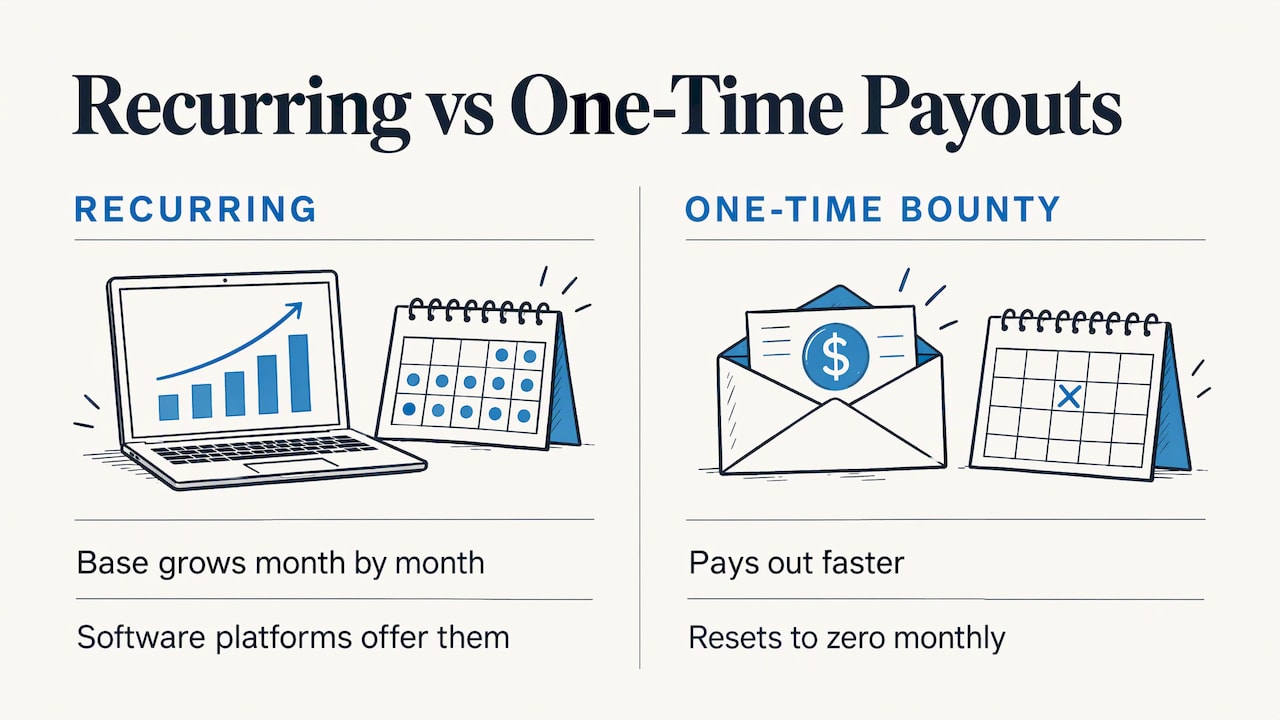
Compare flat fees, percentages and recurring pay for the same audience. Recurring programs, like the recurring affiliate commissions some software platforms offer, build a base that grows month by month, while one-time bounties pay out faster but reset to zero each month.
5. Application requirements
High-ticket programs are pickier. Many want an established online presence, an engaged audience, credible content and a record of successful promotions. Apply with a live site, real content and a clear explanation of how you will promote the product.
6. Product quality
You will put your name next to this product, so use it, or at least see it working, before you recommend it. A weak product with a great commission costs you the audience that makes every future commission possible.
High ticket versus low ticket
Neither is better in every case. They are tools for different audiences.
| High ticket | Low ticket | |
|---|---|---|
| Commission per sale | Hundreds to thousands of dollars | $1 to $20 |
| Sales needed for a goal | Fewer | Many |
| Cookie window | 30 to 180 days | 24 hours to a few weeks |
| Sales cycle | Longer, several touchpoints | Fast, often impulse |
| Entry | Stricter approval | Easy |
| Competition | Often less | Often more |
The figures above come from RedTrack’s comparison, which also notes that affiliates who meet high-ticket requirements can face less competition, because fewer marketers promote the premium product to the same audience.
Many of our readers run both: low-ticket offers like those in an Amazon affiliate site bring steady traffic and small commissions, while a few carefully chosen high-ticket offers monetize the readers who want more depth.
How to start, step by step
- Pick a credible niche. Choose one where you can show experience, not just research.
- Join two or three programs. Look for strong products and reliable tracking. ClickFlare recommends this small number instead of signing up everywhere.
- Build a content platform. A blog, a YouTube channel or an email list. If video suits you, start with our guide to YouTube affiliate marketing for beginners.
- Create trust-building content. High-ticket promotion relies on authority, often through detailed reviews, case studies and testimonials. Show the product in use, state who it is not for, and compare it with alternative types of solution.
- Drive qualified traffic. Search-driven articles aimed at people comparing options will outperform broad traffic. Our blogger SEO tips cover the basics.
- Track from day one. Note which pages send clicks, which clicks convert and how long the delay is between click and sale. Use that to double down on what works.
- Write it into a plan. Set a revenue goal, a content calendar and a budget. Our affiliate marketing business plan walks you through that.
Always disclose your affiliate relationship clearly, where readers will actually see it. It protects readers and it protects the trust your high-ticket sales depend on.
What high-ticket content looks like
Think of one high-ticket article as a sales conversation in writing. The reader arrives with a problem and a budget, and wants proof that spending real money is smart. A strong page usually includes:
- A plain statement of who the product is for and who should skip it.
- The price, what it includes and what it replaces.
- A walkthrough with screenshots from real use.
- A simple return-on-investment example, with numbers labeled as an example.
- Answers to the objections you hear most, from cost to time to refunds.
- One clear link, placed where the reader is ready to act.
The goal is not to push. It is to make the decision easy for someone who was already close.
Our perspective on high-ticket affiliate marketing
We have spent years building online businesses, buying courses and testing tools with our own money, and the pattern is consistent: the affiliates who last are the ones whose readers trust them.
High ticket makes that trust visible. One sale can pay more than a month of low-ticket clicks, but the reader will not hand over a few hundred dollars because you wrote “best” in a headline. They want to see how you use the product, what went wrong and what you would do differently.
That is why we put so much into walkthroughs, candid reviews and first-hand experience from our own businesses. It is also why we recommend starting with fewer programs and going deeper on each. A single honest, well-researched review of a product you understand beats ten shallow roundups.
Learning from people who have done this speeds everything up. Our own education is a big part of how we got here, and we share what we learned in a decade of spending on online courses so you can skip some of the expensive mistakes.
Nathaniel
Learn the system with Instant Course Access for Life
If you want a structured path rather than piecing tactics together, our Instant Course Access for Life gives you ongoing access to our training for a $97 one-off payment. It is built for entrepreneurs, bloggers and freelancers who want practical, real-world strategies for growing an online business, including affiliate income.
See Instant Course Access for Life for the details. If you would rather start free, grab the resources on our free downloads page first.
Mistakes that cost high-ticket affiliates sales
- Chasing the biggest number. A $2,000 commission on a product your audience cannot afford is worth nothing. Match the offer to the reader’s budget.
- Ignoring the cookie. Content that takes weeks to convert needs a program that gives credit for weeks.
- Promoting too many offers. Each one splits your credibility and your analytics.
- Skipping the refund terms. Know when commissions become final before you forecast income.
- Expecting fast results. Authority builds over months. Plan your finances for the lag, and keep a lower-ticket income stream running while you build.
If you are earlier in your journey, our guide to how to build an online business covers the foundations that high-ticket income sits on.
FAQ
What is high-ticket affiliate marketing?
It is promoting expensive products or services in exchange for a large commission per sale, commonly from $100 to several thousand dollars. Definitions of the threshold vary, and some guides set it at $500 or more. You earn through a flat fee, a percentage or a recurring share.
Can you make $10,000 a month with affiliate marketing?
Yes, but it is uncommon. One 2026 guide says it usually takes years of work, strong traffic, a profitable niche and high-paying or recurring offers. High-ticket offers reduce the number of sales you need, not the effort of earning trust.
What are examples of high-ticket affiliate products?
Common examples are business software with recurring commissions, hosting plans, online courses and coaching, and luxury travel bookings. Safari.com, for instance, reports an average referral fee around $600 per closed booking. Always check the current terms on the program’s own page.
Do I need a website to promote high-ticket offers?
Most programs expect some established platform, such as a site, channel or email list, and many ask for credible content and an engaged audience when you apply. A simple blog with a few detailed reviews is a workable start.
Sources
- ClickFlare: High Ticket Affiliate Marketing guide
- Shopify: High-Ticket Affiliate Marketing programs
- RedTrack: Is high ticket affiliate marketing the right approach?
- Faceless Genie: High ticket affiliate marketing explained
- wecantrack: HubSpot affiliate program terms
- Printify: How much do affiliate marketers make?
- irev: How much you can earn with affiliate marketing
- Safari.com affiliate programme
- Track360: Luxury travel affiliate programs playbook
- Post Affiliate Pro: High-ticket affiliate program
- BabyLoveGrowth affiliate program